


Guide to WAKO kickboxing – disciplines, equipment and competition requirements
Guide to WAKO kickboxing – disciplines, equipment and competition requirements
Kickboxing under WAKO (World Association of Kickboxing Organizations) offers several disciplines and strict equipment requirements. Whether you are a beginner, advanced or aiming for competitions, the right knowledge of the disciplines and equipment is essential. Here you will get an up-to-date and thorough guide that explains the different WAKO disciplines (with a focus on light contact, full contact and K-1), which equipment requirements apply, recommendations for specific equipment for each discipline, as well as important competition requirements for athletes and clubs. We also look at the difference between training equipment and competition equipment – for example, why training gloves should be 12–16 oz instead of the lighter competition gloves.
Read on to learn about the disciplines, understand the new rules for approved equipment (including the UV mark that will be mandatory), get tips on gloves, shin and ankle protection, and ensure that both you and your club meet the requirements for safe and fair kickboxing.
WAKO disciplines: Light contact, Full contact and K-1
WAKO kickboxing consists of several disciplines – both pure ring sports and mat/tatami sports. Here we focus on three of the most popular competition disciplines: light contact, full contact and K-1. Before we get into the details of equipment, let's understand what characterizes these fighting styles.
Light Contact
Light contact kickboxing can be described as an intermediate genre between semi-contact (pointfighting) and full contact. The fights are fought on the mat (not in a boxing ring) and are continuous without stopping when hit, but punches and kicks must be performed with controlled force. The aim is not to knockout, but to score points with technically clean hits with reduced force. The judges judge more strictly on control and technique in light contact than in full contact, and the athletes must show good mastery of their techniques without "going too far" in each action. This branch is popular with beginners and younger athletes, as it allows you to compete continuously as in full contact but with far less risk of injury.
Equipment in light contact: Because the competition involves continuous fighting time and moderate force, the athletes must be well protected. Typical equipment includes a helmet, 10 oz boxing gloves (or separate semi-contact gloves), mouthguard, suspensory (crotch protector) and shin and ankle protectors. In light contact – which is fought on a mat with long pants and a shirt – separate shin guards and foot guards are often used. The characteristic foot guards (often called "safety kicks") cover the entire foot and cushion the impact of the kicks on both the athlete and the opponent. These are combined with shin guards that are worn under the pants to protect the shin. WAKO-approved variants are available from the brand TOP TEN, which is the main supplier to Norwegian kickboxing. For example, TOP TEN offers red and blue Safety Kicks in durable, lightweight material that provides optimal shock absorption without hindering movement. Together with matching shin guards, they form a complete set approved for both training and international competition.
Helmet: An approved helmet that protects the head, cheekbones and back of the head is mandatory. Many choose, for example, the TOP TEN Avantgarde helmet or similar models, known for solid shock absorption in Bayflex material. The helmet must fit tightly and cover the temple, ears and forehead well.
Gloves : In light contact, 10 oz WAKO-approved gloves are used (typically the same type as in full contact). These gloves have special padding that reduces the impact force. An example is the TOP TEN WAKO-approved boxing glove 10 oz – the official WAKO competition glove in leather with PPS foam, approved for all WAKO tournaments. It weighs 10 oz and provides optimal shock absorption thanks to the unique BAYFILL® foam, which has reduced the knockout rate internationally to less than 1% after such gloves and helmets were mandated. (Note: for training, use 12–16 oz gloves instead – more on this later.)
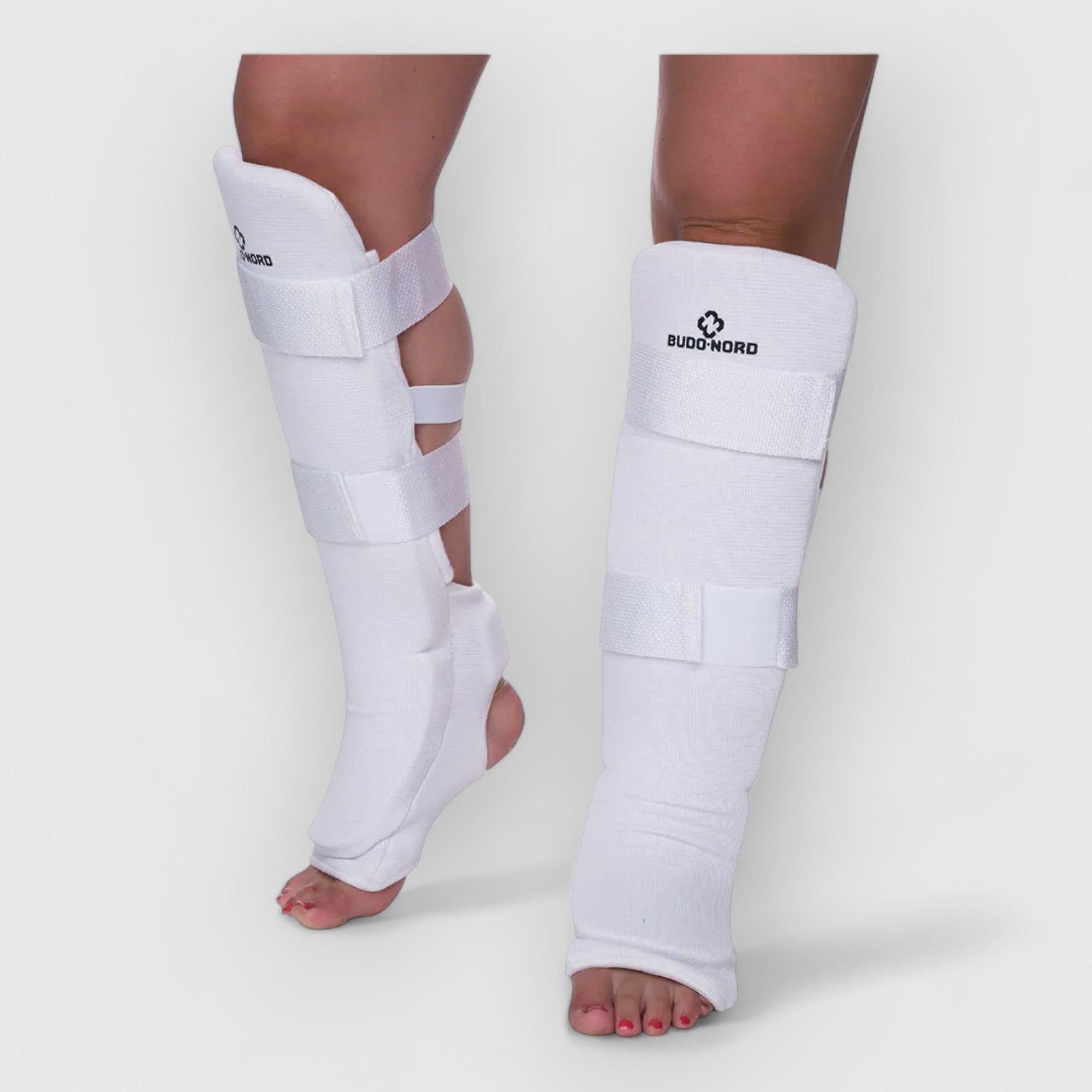
Shin and ankle guards: Light contact requires separate shin and ankle guards. TOP TEN Ultra Light shin guards (“Safety Kicks”) are used in conjunction with TOP TEN shin guards. Safety Kicks are secured with straps under the foot and around the ankle, and cover the entire foot (toes, instep and heel) to protect both the kicker and the receiver. The shin guards cushion the shin and are worn under the pants. WAKO-approved shin and ankle guards from TOP TEN meet international safety requirements and are the first choice for serious athletes.
Other: Mouthguard (preferably double type for best protection of both upper and lower teeth) is mandatory. Furthermore, everyone must wear a suspensory (crotch protector) under their pants, for both men and women. Women may also wear approved chest protection under their tops. All jewelry, watches or piercings must be removed; tape over piercings is not allowed – it must be removed before the match.
Textile tip: Light contact athletes compete in long kickboxing pants (without a grading belt) and a club jersey/t-shirt. The clothing should allow freedom of movement and be without hard parts. From 2027, clothing will also have to have the WAKO label in championships, but as of today, neutral pants and jersey are sufficient in national competitions.
Full Contact
Full contact is the classic professional form of kickboxing as it has been practiced since the 1970s and 80s. It can be compared to boxing, but with high kicks to the same points of impact as are allowed for punches (i.e. the opponent's head and torso). In full contact, punches and kicks are firm and powerful, and knockouts are allowed. The fights take place in a boxing ring - typically 3 rounds of 2 minutes each for amateurs. This is a physically demanding sport where fitness, changes of pace and strength play a central role. Practitioners must have both the punching power of a boxer and the kicking skills of a karate practitioner, since at least as much use of legs as of hands is expected. Full contact (and low-kick, see under K-1) is subject to the Norwegian Knockout Regulations, which impose additional requirements for safety and medical follow-up.
Full-contact equipment: Since this is a ring sport with knockout potential, full safety equipment is required to greatly reduce the force of the techniques. Amateur athletes must wear an approved helmet, mouthguard, gloves, foot and shin guards, and suspension. The requirements overlap a lot with light contact, but there are some differences in equipment selection because the fights are tougher:
Helmet: Mandatory in amateur full contact. Use a WAKO approved helmet (red or blue based on corner color). TOP TEN helmets (e.g. Avantgarde or Fight model) are common, as they are designed to provide good protection around the jaw, temple and back of the head. The helmet must be approved by the referee before the start of the match and must be flawless and clean.
Gloves: WAKO 10 oz competition gloves are used in full contact (same as in light contact). They must be molded boxing gloves with shock-absorbing elastic padding that does not bunch. As mentioned earlier, TOP TEN's 10 oz WAKO gloves are standard in both Norwegian and international championships. The gloves come in a red or blue design and now have the new UV mark that proves WAKO certification. Tip: For training, full contact athletes should use heavier sparring gloves (12–16 oz) instead, for extra padding – we will return to this below.
Shin and ankle protectors: In full contact (above belt height), the foot must also be protected. Traditionally, athletes here use the same type of shin guards and foot protectors as in light contact, i.e. separate parts. The advantage is full coverage of the foot: The foot protector should cover the entire foot, ankle and heel and fit well throughout the match. TOP TEN's competition-approved foot protectors (Safety Kicks) satisfy this requirement. These are combined with matching shin guards without hard materials (to be worn under the trousers). An alternative that some athletes use in training are so-called combined shin/ankle protectors (complete shin guards with ankle support and ankle padding, similar to Muay Thai kick protectors). These can provide even better stability, but note that they must cover the foot sufficiently to be allowed in WAKO competitions. For safety reasons, the classic separate WAKO-approved protectors are recommended in competition, while in training you can use stronger continuous shin/ankle protectors to withstand more hard kicks. At CombatStore you can find both types – e.g. TOP TEN shin and ankle protectors “WAKO Style” for fighting and thicker Venum Elite Leg and Ankle Protectors for sparring.
Clothing: In full contact, men must compete bare-chested (with long pants), and women must wear a neutral, tight-fitting top under the pants. The pants have an elastic waistband (not a drawstring) and no grading belts. Only club badges and any federation badges are permitted on the pants/shirt - advertising requires special permission. Remember that from August 2026, the NKBF will require gloves and helmets to be red/blue (depending on the corner) in national events, and also recommends red/blue shin and foot protectors.
Medical requirement: Because full contact allows KO, the athlete must have a medical certificate. Everyone who competes in full contact must present a valid match book with a medical certificate before the event. A doctor also checks the athletes before weigh-ins/fight to ensure they are fit to fight.
K-1 (Full contact with low kicks and knees)
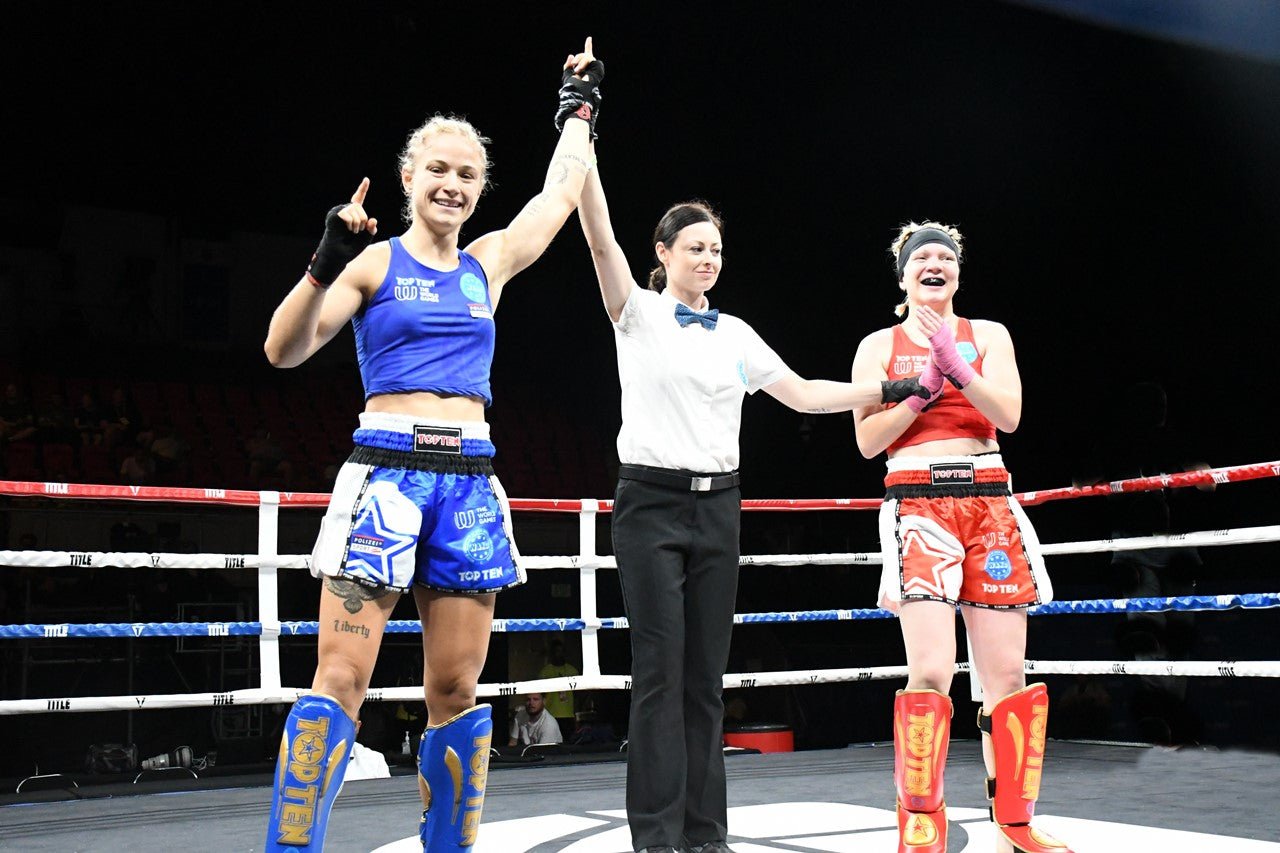
Image: Kickboxers in a K-1 match wearing helmets, mouth guards, 10 oz gloves, and shin and foot guards. K-1 rules also allow knee kicks, as illustrated here.
K-1 is the most complete and toughest branch of WAKO kickboxing. The rules are similar to full contact with the addition of low kicks and knee strikes. The difference from regular full contact is that thighs and calves are also legal points of contact, and that knees can be used as a scoring technique. In K-1, you can also perform a short-term clinch: it is allowed to hold the opponent's head/neck with two hands to pull to one knee, but the clinch must be released within 5 seconds. Elbows are not allowed in WAKO K-1, and there are restrictions on traditional Muay Thai rituals (e.g. no Wai Kru, no use of bracelets or headgear). The fights are fought in a boxing ring with the same rounds as full contact. K-1 requires great versatility - the athlete must master full boxing, high and low kicks, as well as knees to win. This branch is very action-packed and popular in the professional scene, but within WAKO it is run as an amateur format with protective equipment.
Equipment in K-1: Because K-1 allows low kicks to the legs and knee kicks to the body/head, it places even higher demands on the protection of the athletes. The equipment list is basically the same as full contact: helmet, mouthguard, gloves, suspension and shin/ankle guards are mandatory for amateurs. Some adjustments and recommendations stand out:
Helmet and gloves: Same requirements as full contact. 10 oz WAKO approved gloves (red/blue) with UV marking are used, and a safety approved helmet (red/blue) must be worn. This protects against the hard punches of boxing and at the same time against impacts from clinch situations and knees. The referee always checks that the helmet and gloves are correctly marked and in order before the match.
Shin and ankle guards: In K-1, where low-kicks are common, it is common to prefer combined shin/ankle guards (one continuous unit per leg) rather than separate pieces. The reason is that with continuous kicks to the thigh and calf, pure “safety kicks” on the foot can slip more easily, and a complete shin guard with an instep piece tends to fit better through hard clinches and kicks. For example, a fighter can use a pair of solid Venum Elite or Impact shin guards that cover the front of the shin and ankle well. The most important thing is that they cover the back of the foot properly (some Thai boxing guards may have an open toe - be aware that WAKO requires protection of the ankle/toes). Many K-1 fighters still use WAKO-approved TOP TEN shin and ankle guards (red/blue) that are made specifically for this sport, as they combine lightweight construction with good shock absorption. Regardless of the choice, both the calf and foot must be protected – although K-1 allows for more power, the equipment should cushion the impact of low kicks to avoid serious leg injuries.
Knee pads: Although knee kicks are allowed, most people do not use their own knee pads in K-1 as it can hinder mobility. Knee kicks are primarily performed to the body/head, and WAKO does not require padding on the knees. It is important to practice performing controlled knees in amateur K1 to avoid disqualification (you should not knee directly to the face without control). If desired, a simple neoprene knee pad can be used for your own support, but this is not mandatory equipment.
Clothing: K-1 follows the same clothing rules as low-kick: shorts with elastic at the waist (not Thai shorts with traditional text, only neutral). No tops for men, and sports bras/body tops for women as usual. The shorts should not bear Muay Thai names or symbols according to the NKBF regulations (to distinguish it as a separate sport). In practice, similar shorts are used as in Muay Thai, only without religious symbols. From 2025/2026, WAKO labels will be required on shorts in major championships, but in local events, regular martial arts shorts are okay (club shorts with a logo are often used). Remember the color requirements again: in the future, helmets/gloves (and preferably shins/ankles) should be red/blue according to the corner - good to note when buying equipment.
Note: One point about K-1 is that it is a ring sport with knockout, so all requirements for license, age and skill apply as for full contact. In Norway, this means that K-1 athletes must be 18 years old, have passed the full contact 'gold mark' (possibly a gold mark specific to the K-1 branch) and have an approved medical certificate in the match book.
Approved equipment: WAKO rules, UV label and difference between training vs competition
An important part of WAKO kickboxing is the safety requirements for equipment. WAKO has its own certification system for fighting equipment, and from 2025 this will be further tightened with the introduction of a new international mark (UV label). Let's see what this means for you as a practitioner:
WAKO certification and UV mark
Having WAKO-approved equipment means more than just a logo on the product. It is a guarantee that the equipment has been thoroughly tested and meets high standards for safety, quality and performance. As of January 1, 2025, all WAKO-approved products are also required to be marked with an official UV Label. This new label contains a special tracking label that can be read with UV scanning to confirm that the product is authentically certified.
For you as an athlete, this means that older equipment with only the text "WAKO approved" or the old WAKO Germany mark without UV will not be valid in WAKO competitions after the end of 2024. Specifically: Equipment with old WAKO markings can be used until 2024, but in 2025 all competition equipment must have the new UV mark. The mark is usually integrated from the factory on newer equipment (e.g. a small label sewn or glued on gloves, shin guards, etc.).
Can UV labels be purchased separately? Basically no – WAKO wants to avoid certification fraud, so they do not sell UV labels loose on the open market. The exception is a transitional arrangement: CombatStore offers UV labels to customers who purchase WAKO-approved equipment with old markings in 2024/25, so that they can upgrade their equipment. However, if you only order a UV label without an associated equipment purchase, the order will be deleted. This ensures that UV labels only end up on equipment that actually meets the requirements.
What does the UV badge look like? It is a small sticker/emblem with holographic/UV reflective printing, which comes in two sizes: a smaller one for equipment (approx. 2.3×3.4 cm for gloves, shin guards, etc.) and a slightly larger one for clothing (3.5×4.5 cm for pants, jerseys). The badge has the WAKO logo and a unique serial number/EAN. When purchasing new equipment, check that this badge is on – especially for gloves and pads that will be used in tournaments.
Does all equipment need to be WAKO-approved? For official competitions under the auspices of WAKO or NKBF, the answer is in practice yes for the most important equipment. WAKO requires approval for gloves, head protectors, foot/leg protectors and competition clothing at NM, World Cups, European Championships, etc. In Norway, there is a small transition period: until mid-2026, NKBF will allow some use of previously approved equipment without a new WAKO label, but from August 2026 all equipment in national competitions must have a valid WAKO label. As early as January 2026, everyone competing internationally must have full equipment with the WAKO UV label. It is strongly recommended to upgrade equipment well in advance of these deadlines.
Competition equipment checklist
When preparing for a convention, you should go through a quick check of your equipment:
- Boxing gloves: Check that they have WAKO approval and a UV mark. Competition gloves should be 10 oz (for seniors) and fit snugly with good wrist support. The padding should not be worn out – the padding must still provide strong impact absorption.
- Protective equipment: Helmet, mouthguard, shin guards and any foot guards are mandatory requirements. Everything must be WAKO certified and now also have a UV label. For example, TOP TEN WAKO shin guards with a UV label are recognized for their comfort and high safety, and are a safe choice. Check that the Velcro straps and seams are intact so that they do not fall off in the middle of the match.
- Competition clothing: The correct uniform for the branch (trousers + possible top, or shorts) according to the rules. The clothing should provide maximum freedom of movement without compromising safety (no zippers, buttons, etc. that could cause damage). As mentioned, from 2027, clothing must also have the WAKO label in the highest championships, so it may be wise to buy approved clothing now if you are betting. In the meantime: wear what is standard – e.g. kickboxing pants and club T-shirt for light contact, or neutral shorts for K-1.
- Additional accessories: Some items are not required by WAKO, but can be smart to have of high quality. This includes hand wraps (inner wraps for wrist support), ankle supports (can provide extra stability when kicking, especially for light contact/kick-light athletes), and possibly knee supports. Since these do not require WAKO approval, you are freer, but choose robust products - they can make the difference between injury and injury-free after a long day of competition.
Equipment for training vs. competition: It is worth emphasizing that equipment required in competition can often (and should) be supplemented with heavier or extra protective equipment in everyday training. We now turn to some equipment recommendations and tips, especially with regard to training.
Equipment recommendations and training tips
In addition to the competition equipment itself, it is important to have good equipment for daily training and sparring. Training equipment often aims to be even more protective, durable and comfortable, since it is used more often and for longer sessions. Here are some general recommendations that apply regardless of the branch:
Training gloves (12–16 oz): For sparring in training, you should use thicker gloves than your competition gloves. Sparring gloves provide optimal protection for both you and your training partner, with extra padding to reduce the risk of injury and ensure comfort during long sessions. Typically, 12 oz is chosen for lighter athletes/women, 14 oz as an all-rounder, and 16 oz for heavier athletes or hard sparring. These gloves will protect your opponent's face and your own hand much better than thin competition gloves. A good choice could be, for example, the Venum Challenger 14 oz or TOP TEN Sparring 16 oz gloves. The point is: always use larger gloves in training than in combat - then you will avoid unnecessary cuts and concussions in the club.
Protective equipment for sparring: It may be tempting to train without a helmet for better visibility and less heat, but remember that frequent hard sparring without head protection increases the risk of head injuries. Therefore, use a helmet in sparring training that mimics combat. A mouthguard is of course a must for all contact training. Feel free to use a cheaper version for everyday use and save a molded one for combat, but use it!
Shin and foot protectors for training: Here you can consider using even more padded versions than you would go into a fight with. Especially K-1/lowkick athletes can invest in thick shin guards (kickboxing/Muay Thai-style) for sparring, so that you can practice low kicks with minimal chance of bruising or breakage. At the same time, light contact athletes can perhaps train with slightly lighter foam protectors for better mobility when not kicking with full force. In any case: always wear protectors on your shins/feet when practicing kicks against each other - kicking each other without shin guards is a sure way to get injured.
Additional supports and protection: Consider using supportive ankle socks (to prevent overpronation), elbow pads (if you practice a lot of blocking, for example), and perhaps a light armor/chest protector for hard body sparring. Many clubs allow athletes to train with some extra protection to be able to perform harder exercises. This equipment is not mandatory in combat, but can extend your career by reducing wear and tear.
Requirements for athletes and clubs (license, age and skill level)
Finally, we include some important athlete and club requirements that are relevant to those who want to compete in WAKO kickboxing:
Club membership and license: To participate in official competitions, you must be a member of a club affiliated with the Norwegian Kickboxing Association (NKBF/WAKO). The club will help you issue a match book/license each year, which includes insurance and registration as a competitor. The license usually includes a medical check for full-contact competitors. The club must also provide a second/coach with an approved second course at competitions.
Age limits: WAKO allows children and youth to compete in pointfighting, light contact and kick-light from a relatively young age (preferably 10 years and up in children's classes, with modified rules). Full contact and K-1, on the other hand, are strictly reserved for seniors: 18 years is the minimum age for these KO disciplines. There are junior versions of full contact in some countries (16–18 years) with additional restrictions, but in Norway you are required to be of legal age to participate in knockout disciplines.
Skill requirements: NKBF has a system of tag matches (bronze, silver, gold) to qualify athletes for full contact/ring. To enter their first full contact or K-1 match, the athlete must have passed the gold mark in sparring. The gold mark is a controlled match (full contact light, we could say) led by judges/doctors, where the athlete shows that he/she has mastered full contact technically and mentally. The athlete is required to have at least a yellow/orange belt and have taken bronze and silver marks along the way. In short: you must have some experience from light contact/club matches before being allowed into the ring. This increases safety considerably. Your club will help you through the tag match system if you focus on the ring disciplines. For light contact and pointfighting, there are no corresponding mark requirements, but it is recommended to grade yourself (belt system) and have some club events under your belt before going to a national event.
Medical follow-up: All competitors in knockout disciplines must have a health certificate in their fight book that is no older than 1 year (renewed with a medical examination annually). In addition, you must undergo a medical check-up at weigh-in, and there is a doctor present during the events who can stop fights. If you get a knockout or serious injury, your license will be quarantined (e.g. 30 days without a fight in case of KO). This is for your own safety. Your club should follow up that you take the necessary breaks after hard hits, even in training. In light contact, knockouts should not actually occur - if they do, it indicates a rule violation or too hard contact, and a disqualification or RSC is usually issued.
Club requirements: Clubs that organize events must provide an approved ring/mat, first aid equipment and qualified medical personnel (doctor). For an event to be approved, it must be entered in the schedule and have authorized judges from the NKBF. As an athlete, you can generally trust that such formalities are taken care of, but it never hurts to know that things happen according to the book.
Finally – equipment suppliers
NKBF encourages all clubs and athletes to purchase WAKO-approved equipment from official partners. In Norway, CombatStore/Top Ten is the main sponsor and supplier for the association. This means that at CombatStore you will find everything you need in terms of WAKO-approved equipment – from gloves and helmets to clothing. Other brands such as Adidas, Century, RDX and others also have WAKO-approved products, but these are not as easily available in Norway yet. Fortunately, the Top Ten products cover most of the needs.
If you have heard about special glove models from abroad (e.g. popular news from Budoland.com / Top Ten that are not yet on CombatStore), it may be good to know that these are probably on their way in. For example, TOP TEN has launched new 4Select gloves (synthetic multi-foam gloves for training/competition) and an exclusive Prestige series of gloves and helmets - these are marked as "coming soon" at CombatStore. However, you should primarily focus on the equipment that is actually available now via CombatStore, as this has been tested and approved.
With the right understanding of the disciplines, the right equipment in your bag and knowledge of the requirements, everything is in place for a safe and exciting journey in kickboxing. Good luck – whether you train for fun, aim for the podium in the Norwegian National Championships, or dream of international WAKO success!
Sources
This guide is based on updated information from the Norwegian Kickboxing Federation and CombatStore (NKBF's official equipment supplier). Requirements and rules are taken from NKBF's regulations and latest guidelines, as well as CombatStore's own recommendations and product specifications. Should you need more details, please refer to WAKO's official regulations and NKBF's websites.
```